Midlife Career Change: How to Tell if It’s Burnout, Mental Load, or Misalignment
Many women reach midlife and notice something subtle but persistent: work suddenly feels heavier than it used to. What often looks like a sudden desire for a midlife career change is sometimes something deeper: accumulated cognitive load and mental exhaustion.
The same job, the same responsibilities, even the same environment — yet your nervous system responds differently.
When the brain has been managing years of decision-making, emotional labor, and responsibility, even a job you once enjoyed can start to feel neurologically expensive.
Understanding whether this is a need for a new career or a need for a new way of managing your cognitive capacity is the first step toward reclaiming your joy.
If You’re Skimming, Here’s the Bottom Line
If you’re trying to discern whether this is burnout or a true midlife career change, look for patterns:
- If relief comes with rest → it’s likely burnout.
When time off, boundaries, or reduced demands restore your energy, your nervous system was overloaded — not misaligned. - If relief never fully comes → it may be misalignment.
When something still feels heavy even after rest, that’s deeper information. - If you feel pressured every morning → your nervous system is under strain.
Chronic bracing is a signal that your daily environment requires more regulation than it gives back. - If you feel drained but calm on vacation → the issue is likely situational.
Your system can regulate — it just struggles in your current work context. - If you feel drained everywhere → you may be carrying deeper emotional exhaustion.
That’s not a career problem alone — that’s a capacity issue that deserves support.
Discernment isn’t about dramatic decisions. It’s about noticing where relief exists — and where it doesn’t. And keep in mind that the answer to burnout is recovery, while the answer to misalignment is recalibration.
When Career Friction Is Actually Cognitive Load
Many women assume the urge for a midlife career change means they need a new job.
But often the deeper issue is mental bandwidth.
By midlife, many women are managing:
- caregiving responsibilities
- emotional labor at home
- complex work expectations
- constant decision-making
- the invisible mental load of coordinating daily life
Over time, this creates what psychologists call cognitive load — the amount of information and responsibility the brain is managing at once.
When that load becomes too high, the brain begins conserving energy. This type of mental overload is closely related to what I describe in How to Reduce Cognitive Load in Midlife.
That’s when work can start to feel heavier, even if the job itself hasn’t changed.
In other words, the problem isn’t always the career.
Sometimes it’s the mental bandwidth required to sustain it.
The Neuroscience of the Midlife Shift: Why Work Feels “Heavier”
From a brain-based perspective, midlife often brings a physiological shift in how we process professional stress. For decades, you’ve likely relied on your prefrontal cortex to manage the friction of demanding multitasking, tight deadlines, and complex office politics. You used logic and willpower to “power through.”
However, as we age, our nervous system begins to prioritize regulation and safety over hustle performance. When your job creates constant mental noise, your brain’s threat center—the good ole amygdala—stays in a state of subtle, chronic activation. What used to feel like an “exciting challenge” in your 30s can start to feel like neural friction in your 50s. This isn’t a loss of ambition or motivation; it is your brain signaling that your current environment is consuming more “bandwidth” than your nervous system is willing to give.
When the friction becomes constant, your brain enters a state of chronic bracing. This is why you feel exhausted before the day even begins; your system is literally working overtime just to keep you regulated in a misaligned environment.
If life in general feels heavier lately, you may want to read Why Everything Feels Harder in Midlife.
“I Don’t Really Hate My Job, So Why Do I Feel Like I Want to Change Careers?”
This is one of the most common and confusing places women find themselves in midlife.
You don’t hate your job. You may even be good at it. You’re competent, reliable, and experienced. On paper, nothing is wrong. And yet, there’s a persistent sense that something doesn’t quite fit the way it used to.
What’s often changed isn’t the job itself — it’s your capacity.
At this stage of life, everything carries more weight. Emotional labor feels heavier. Noise feels louder. Constant interruptions and decision-making feel more intrusive. What once felt manageable now requires more effort, more recovery, more of you.
Work that used to slide neatly into your life may now spill over into the parts of your day you value more — your evenings, your relationships, your energy, your sense of calm. You may find yourself more sensitive to inefficiency, unnecessary stress, or demands that eat away at your personal time.
When that happens, it can feel confusing. You might wonder why you’re feeling this way when nothing is technically “wrong.” But feeling off doesn’t mean the job is horrible — and it certainly doesn’t mean something is wrong with you. It usually means you are the one changing, even if your role hasn’t.
The Difference Between Burnout and a True Midlife Career Change
This distinction matters, because burnout and misalignment feel similar on the surface — but they respond very differently.
Burnout is usually situational. It improves with rest, better boundaries, or a temporary reduction in demands. When burnout is the issue, small changes help. Time off brings relief. Adjustments restore some balance and make you feel better about your career or job.
A misalignment, on the other hand, tends to linger.
Even when things “get better,” something still feels laborious. You may have already tried tweaking your schedule, improving your routines, shifting your mindset, or putting systems in place to make work more manageable — and yet the nagging feeling remains. There’s a quiet resistance that doesn’t go away.
Many women reading this aren’t new to doing the mental work to align yourself mentally with the demands of everyday work and career. You’ve already done the reflection, the personal growth, the boundary-setting. If this were just burnout, something would have eased by now.
When it doesn’t, that’s information worth paying attention to.
Signs It May Be Time for a Midlife Career Change
Instead of focusing on fleeting emotions, it’s more helpful to notice patterns — especially the ones that show up consistently over time.
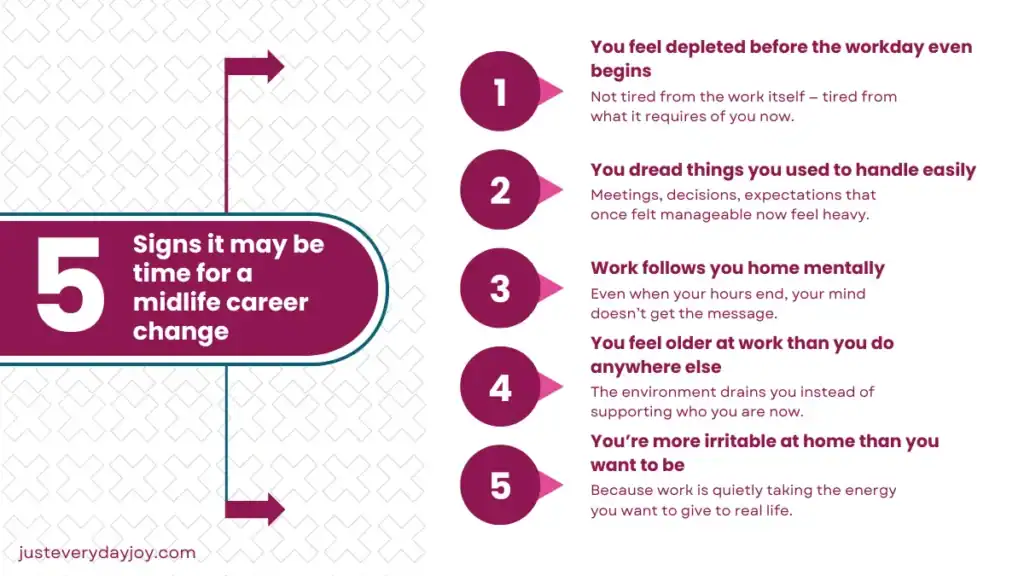
You might recognize yourself in some of these experiences:
- You feel depleted before the workday even begins, not because you’re lazy, but because your system is already bracing for the daily drain.
- You dread tasks you used to handle easily, even ones you’re still capable of doing well.
- Work follows you into the evening mentally, even when there’s nothing urgent to finish.
- You feel older (or physically not well) at work than you do anywhere else, as though the environment magnifies fatigue instead of supporting you.
- You notice yourself more irritable or impatient at home, not because of your family, but because work is consuming more of your emotional bandwidth than you want it to.
These signs aren’t always dramatic. They’re quiet, persistent, and easy to dismiss — which is why so many women ignore them longer than they should.
Why So Many Women Stay Longer Than They Should
There are very real reasons women remain in roles that no longer fit, especially at this stage of life.
Loyalty runs deep. Financial responsibility is non-negotiable. Many women have built identities around being capable, dependable, and good at what they do. There’s also a reluctance to seem ungrateful or dramatic after years of steady contribution.
And for many, the idea of “starting over” raises understandable fear. You may wonder is it too late to change careers at 50, or whether leaving something familiar makes sense when you’ve already invested so much time and energy. The voice telling you it’s ‘too late’ or that you’re being ‘ungrateful’ is your Inner Critic trying to keep you in a familiar (but draining) survival loop. Joyful aging requires handing the microphone to your Inner Coach, who recognizes that reclaiming your time is a form of self-leadership, not failure.
Staying doesn’t mean you’re wrong. It means the decision is complicated. This isn’t about judging yourself for staying — it’s about understanding why you’re staying and whether those reasons still align with the life you want now.
Many women experiencing this friction are also dealing with decision fatigue in midlife.
What Women Over 50 Are Actually Looking For in a Career Change
Despite what most career advice suggests, women over 50 aren’t usually looking for reinvention, passion projects, or proof that they still “have it.” At least I know I’m not!
Most are looking for something meaningful and purposeful…something that lights us up and is life-giving.
We’re looking for relief. For work that fits our current energy instead of constantly stretching it. For dignity and predictability instead of perpetual adaptation. For roles that leave space for health, relationships, and enjoyment beyond work.
A midlife career change at this stage is rarely about ambition. It’s about fit. It’s about choosing work that supports the life you’re living now, not the one you were living twenty years ago.
Questions to Ask Yourself Before Making a Midlife Career Change
You don’t need answers to all of these right away. These questions aren’t meant to push you toward action — they’re meant to make you pause and bring clarity.
- What part of the job is causing emotional exhaustion at work, and why?
- What feels heavier now than it used to, even if the job hasn’t changed?
- What would feel like relief in my work life — not success, not advancement, just relief?
- What am I no longer willing to sacrifice for a paycheck?
These aren’t questions you answer once. They’re questions you sit with, return to, and notice how your answers evolve over time.
If You’re Not Ready to Make a Midlife Career Change
Most women aren’t ready to make a move the moment they start questioning. And that’s perfectly okay.
You don’t have to decide anything today. Awareness itself is a meaningful first step. Sometimes the most helpful thing you can do is experiment gently — adjusting boundaries, reassessing workload expectations, or protecting your energy more intentionally.
Related post for ideas on adjusting work expectations to reduce mental noise: How to Stop Dreading Work Every Day
Listening doesn’t require action right away. It requires honesty and patience, both of which you’ve already cultivated through years of experience.
Conclusion: Using the Joy Framework for Career Discernment
If you are standing at the crossroads of a midlife career change, the goal isn’t to rush into a new “hustle.” It is to move from a state of survival to a state of work joy. We do this by applying the three pillars of the Joy Framework to your professional life:
1. Release: Letting Go of the Gen-X “Shoulds”
The first step in reducing career friction is identifying the “mental noise” of expectations you’ve been carrying for decades. It creates neural friction. Many of us are still trying to satisfy the ambitions of our 30-year-old selves.
- The Shift: Release the idea that staying in a draining role is a sign of “strength” or “loyalty.”
- The Action: Acknowledge that your capacity has changed, and that letting go of a misaligned role is a strategic move for your nervous system, not a failure of your work ethic.
2. Reclaim: Honoring Your Current Pace
Once you release the old narrative, you can begin to reclaim what a “good day” actually looks like at this stage of life. This is where you find your Clarity.
- The Shift: Stop asking, “What is the next big move?” and start asking, “What pace feels sustainable now?”
- The Action: Re-engage with your values. Reclaim your right to a job that offers relief and dignity rather than just more responsibility. This is about finding work that fits your life, not a life that fits your work.
3. Rewire: Building Protective Habits
You don’t have to quit your job today to start finding joy. Rewiring is about the small, daily shifts that protect your energy while you discern your next move.
- The Shift: Move from “bracing” for the workday to “buffering” your nervous system.
- The Action: Build small “Joy Buffers”—a 10-minute walk before work, a strict “no-email” boundary after 6:00 PM, or using the 5-4-3-2-1 Technique to stop the overthinking loop. These habits lower the neural friction so you can hear your inner coach clearly.
Many women assume a midlife career change means they need to start over. But sometimes the deeper work is reducing the mental load that has quietly accumulated over decades of responsibility. When cognitive bandwidth is restored, work often feels clearer — and decisions about the future become easier to hear.
Related Reading:
Feeling stuck because you’re “too good” at your job? This post on the accidental expert paradox explains why competence — not fear — often keeps women in midlife from making a change.