Why Everything Feels Harder in Midlife (And It’s Not What You Think)
If you’ve been wondering why everything feels harder in midlife, you’re not imagining it.
Many women reach this stage of life and quietly notice that everyday life suddenly requires more effort than it used to.
Responding to messages.
Planning dinner.
Keeping track of responsibilities.
Making simple decisions.
Nothing dramatic has changed on the outside.
But internally, things feel heavier.
Many women assume something must be wrong with them — that they’ve become less organized, less resilient, or somehow less capable than they used to be.
But the real explanation is usually far more practical.
What many women are experiencing is the impact of cognitive load in midlife — the invisible mental effort required to manage the growing responsibilities of everyday life.
Key Takeaway: If you feel like your brain is running too many open tabs, you aren’t failing—you are experiencing cognitive overload. This post delves into the science behind it and how to regain your focus.
Why Everything Feels Harder in Midlife
When women describe the feeling that everything is suddenly harder lately, they are often responding to a very real neurological pattern.
The brain has a limited amount of mental energy available for planning, organizing, prioritizing, and decision-making.
Over time, that energy gets stretched across more responsibilities.
In my own work as an educator studying brain-based learning strategies, I spent years observing how the brain functions when cognitive demand becomes too high. In classrooms, we see it clearly: when students are asked to manage too many tasks at once, their working memory becomes overloaded and their performance declines.
The same principle applies outside the classroom. For women navigating adulthood — and especially midlife — the brain can reach a point where the total mental demand simply exceeds the available bandwidth.
When that happens, even ordinary life can begin to feel unexpectedly difficult.
This is one of the reasons many women begin experiencing what feels like midlife brain fatigue.
The Hidden Weight of the Midlife Mental Load
One of the biggest contributors to this shift is the midlife mental load.
The mental load is not simply about completing tasks.
It is about keeping track of everything that needs to happen.
Remembering appointments.
Anticipating problems before they even happen.
Coordinating family schedules.
Managing logistics behind the scenes.
Much of this work is invisible. It doesn’t appear on a to-do list, yet it occupies mental space all day long.
By midlife, many women are often simultaneously coordinating:
- work responsibilities
- family logistics
- household decisions
- caregiving for aging parents
- emotional support for children or partners
Each responsibility may seem manageable individually. But together they create a constant stream of mental processing. Over time, that invisible effort accumulates into what psychologists call cognitive load in midlife.
If you’ve ever felt like your brain is holding dozens of open tabs at once, you’re experiencing the effects of this mental load.
I talk more about this dynamic in How to Reduce Cognitive Load, where we unpack how this hidden responsibility quietly drains cognitive energy.
Decision Fatigue in Midlife
Another major factor behind why everything feels harder in midlife is decision fatigue in midlife.
Every decision your brain makes requires mental energy.
And most days involve far more decisions than we realize.
Consider how many small choices your brain processes throughout the day:
What should I make for dinner?
Should I answer this message now or later?
What needs to happen tonight?
Which task should I prioritize first?
Should I say yes to this request?
Each decision may seem small.
But dozens of small decisions add up quickly.
Your brain’s executive function — located in the prefrontal cortex — is responsible for planning, prioritizing, and decision-making.
The challenge is that executive function operates with a finite daily supply of mental energy.
By late afternoon, many people begin experiencing what I often describe as the depletion of their mental Focus Credits.
When those credits run low, even simple decisions can begin to feel exhausting.
If you’ve ever felt strangely stuck choosing dinner or responding to a message, you’re likely experiencing decision fatigue in midlife.
I explore this pattern further in Decision Fatigue in Midlife, where we look at how accumulated decisions drain the brain’s available bandwidth.
The Role of Emotional Labor
Midlife also brings a type of effort that is rarely acknowledged openly: emotional labor.
Many women spend years being:
- the steady one
- the problem solver
- the emotional support system
- the person who keeps things from falling apart, and keeps all the balls in the air
This role often becomes second nature.
But emotional labor is still output.
Supporting others emotionally requires attention, empathy, and mental energy.
Over time, the nervous system absorbs the weight of that responsibility.
This is one reason many women wake up feeling exhausted even after sleeping well.
Their exhaustion is not simply physical.
It’s the result of long-term emotional carrying.
This deeper layer of responsibility is something we explore more in Why Am I Still Tired Even Though I Rest?, where we look at how emotional support roles quietly accumulate over time.
The Midlife “Perfect Storm”
Midlife often becomes a convergence point where several demanding factors overlap.
Many women find themselves navigating:
- the midlife mental load of managing family and logistics
- decision fatigue in midlife from constant small choices
- the emotional responsibility of supporting others
- caregiving for aging parents
- career demands that have increased over time
- hormonal shifts that affect sleep and stress tolerance
Each factor alone might be manageable.
Together they create a perfect storm of cognitive load in midlife.
When that happens, the brain naturally begins conserving energy.
This conservation mode can show up as:
- mental fog
- irritability
- slower decision-making
- difficulty concentrating
- feeling mentally tired even after resting
These experiences are not personal failures.
They are signs that the brain is managing too many open cognitive loops at once.
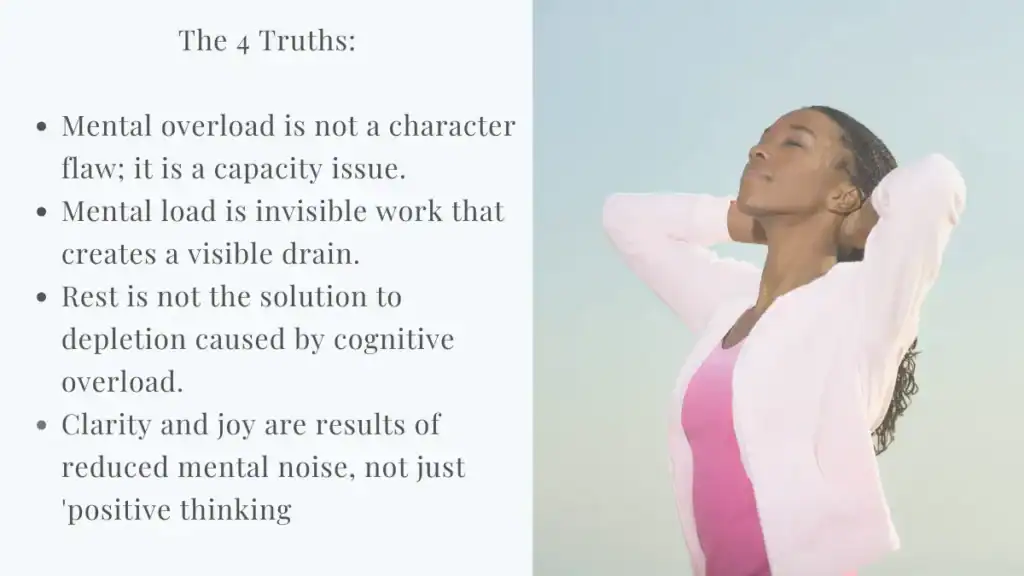
The Good News: Harder Doesn’t Mean Permanent
Understanding why everything feels harder in midlife can be incredibly relieving.
Because once women recognize that the issue is often cognitive capacity, the conversation shifts.
This isn’t about becoming more disciplined.
It isn’t about pushing harder.
Instead, the path forward often involves reducing cognitive load.
When unnecessary decisions are removed, mental loops are closed, and responsibilities are simplified, the brain begins to regain bandwidth.
That’s why strategies designed to reduce cognitive overload — like the ones discussed in How to Reduce Cognitive Load in Midlife — can make such a noticeable difference.
When mental bandwidth returns, something important happens.
Clarity returns.
Patience returns.
And even joy becomes accessible again.
Not because life suddenly becomes easy.
But because the brain finally has room to breathe.
Continue Exploring the Midlife Mental Load Series
If this experience resonates with you, these posts explore the topic further:
• Stop Feeling Overwhelmed in Midlife
• Emotional Wellness in Midlife
• 10 Powerful Ways to Reset Your Nervous System in Midlife
• 12 Monthly Reflection Questions to Pause, Reset, and Realign in Midlife
Together, these posts unpack how midlife cognitive load builds — and how to begin reducing the mental noise so that life starts to feel lighter again.