Decision Fatigue in Midlife: Why Brain Fog Isn’t What You Think
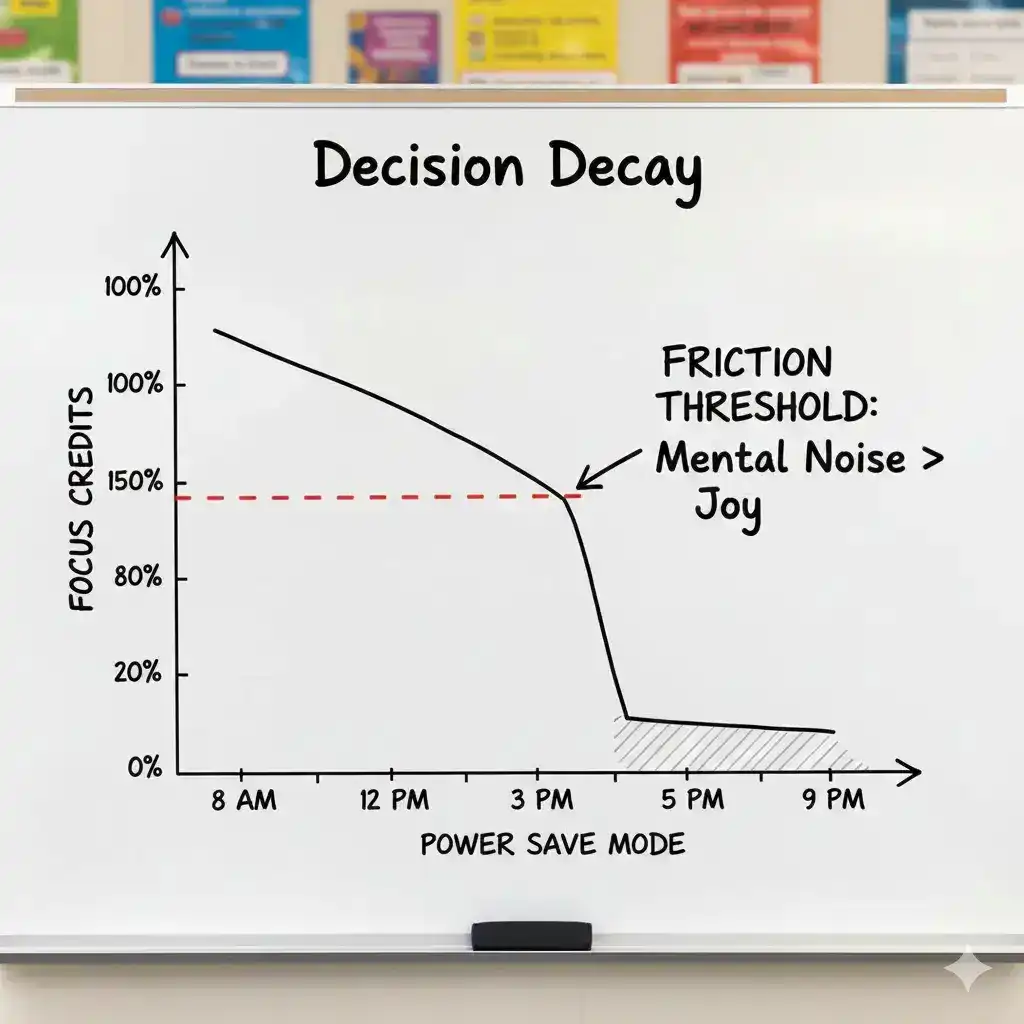
Midlife brain fog is often not cognitive decline — it is likely decision fatigue in midlife caused by accumulated cognitive load. When executive function is overused throughout the day, the prefrontal cortex enters “power save mode,” making joy, clarity, and presence feel physically inaccessible.
If you feel oddly paralyzed by simple choices at the end of the day, you are not losing intelligence.
You are hitting your Decision Limit.
In 25 years of studying and witnessing how brains function under real-world pressure — not just theory — I’ve seen this pattern repeatedly. The brain operates on a limited daily supply of what I call “Focus Credits”. Executive function is not infinite. It is finite and exhaustible. Think of Executive Function as the Air Traffic Controller of your brain. It manages your ‘Focus Credits’ to help you plan, prioritize, and resist distractions. In midlife, the runway is crowded, and the controller is exhausted. 😏
Every choice costs something:
- Which email first?
- What’s the healthiest snack?
- Do I respond now or later?
- Should I say yes?
- What’s for dinner?
That cost adds up.
And in midlife, the “Sandwich Generation” years amplify cognitive demand:
- Coordinating care for aging parents.
- Supporting children emotionally and logistically.
- Maintaining career performance.
- Managing hormonal shifts that affect sleep and stress tolerance.
- Carrying the invisible spreadsheet of everyone’s needs.
This is not overwhelm as a personality flaw.
This is Decision Accumulation.
By late afternoon, your prefrontal cortex — the seat of executive function — is operating in Power Save Mode (think of your computer or phone battery when it dims as it runs out of power). When that happens, the brain prioritizes efficiency over presence.

Joy requires presence.
Presence requires bandwidth.
Bandwidth requires unused Focus Credits.
When the credits are gone, joy feels unreachable.
Not because you’re ungrateful. Because you are neurologically maxed out.
What Are the Real Midlife Brain Fog Causes?
The most common midlife brain fog causes include hormonal shifts, chronic stress, sleep disruption, and — most overlooked — decision fatigue. When executive function is constantly engaged managing sandwich generation stress, the brain reduces clarity to conserve energy.
The Midlife Decision Algorithm: How to Reduce Mental Noise Immediately
To reclaim bandwidth and reduce cognitive load in midlife, you must shift from constant deciding to strategic automating.
In education, we use scaffolding so students don’t waste cognitive energy guessing what comes next. The same principle applies to your midlife brain.
Here is the algorithm:
- 1. Establish “If–Then” Defaults (Hard-Close Cognitive Tabs)
Create automatic rules for recurring decisions.
“If it’s Monday at 6:00 PM and dinner is not prepared, we DoorDash food.”
“If it’s a weekday, I rotate my five pre-chosen outfits. for the week.”
Defaults remove micro-decisions before they occur and preserve executive capacity. - 2. Apply the Rule of 3 (Protect High-Stakes Bandwidth)
Limit yourself to three meaningful decisions per day.
Batch all utility decisions — emails, bills, scheduling — into a single 30-minute block.
This reduces the neurological cost of context switching, which drains Focus Credits quickly. - 3. Use Visual Scaffolding (Externalize Memory)
Create a physical “Launch Pad” for keys and bags.
Use a shared family whiteboard.
Standardize where essentials live.
If you don’t have to decide where something is, you eliminate low-grade background cognitive noise. - 4. Practice the 10-Second Buffer (Teacher Wait Time for Adults)
When faced with a non-essential request, pause for ten seconds before answering.
Check your battery level. 🪫
This small interruption prevents automatic yeses that cost energy you don’t actually have.
Why This Works To Stop Decision Fatigue In Midlife (The Brain-Based Lens)
- It is key to reducing mental overload
- It protects executive function under chronic stress.
- It minimizes context switching, which is metabolically expensive for the brain.
- It reallocates energy upward — toward connection, reflection, and joy.
Neuroplasticity follows repetition.
When you automate the predictable, your brain stops burning fuel on logistics and preserves energy for meaning.
Joy is not missing.
It is buried under unfiltered decisions.
If you are carrying the invisible spreadsheet right now, hear this clearly:
You are not bad at managing life.
You are overspending Focus Credits in a season that demands too many withdrawals.
Reduce the decisions.
Restore the margin.
Joy becomes neurologically accessible again.
Final Note: If this feels bigger than just decision fatigue, you may also want to read why you’re still tired in midlife. The two are deeply connected.
Frequently Asked Questions About Decision Fatigue in Midlife
Why does decision fatigue feel worse in midlife than it did in my 30s?
Decision fatigue often feels stronger in midlife because cognitive demand increases while recovery time decreases. Many women are simultaneously managing caregiving, career complexity, and hormonal shifts that affect sleep and stress tolerance. The volume of decisions hasn’t just increased — the margin for recovery has decreased.
Can too many small decisions really affect mood and patience?
Yes. Even low-stakes decisions require mental energy. When dozens accumulate throughout the day, irritability and emotional flatness often follow. It’s not that your personality changed — it’s that your brain is conserving energy after sustained decision use.
Is reducing decisions more effective than improving time management?
In many cases, yes. Time management organizes tasks. Reducing decisions protects mental bandwidth. When you automate repetitive decisions, you preserve energy for meaningful decisions (and joy) rather than simply rearranging a crowded schedule.