How to Reduce Cognitive Load in Midlife
Cognitive overload in midlife refers to the total mental effort required at one time to manage decisions, responsibilities, emotional labor, and environmental noise during the 40–60 season of life. When cognitive load is high, mental noise increases — and joy feels harder to access. To understand how to reduce cognitive load in midlife, we first need to realize that it isn’t about becoming more productive. It’s about conserving mental energy so your nervous system can stabilize, your decisions feel lighter, and daily life requires less friction.
Think of it like this: Reducing cognitive load is like managing an energy budget. Your brain has a finite amount of processing capacity each day. In midlife, the fixed costs quietly rise — emotional labor, layered roles, constant decision-making. If we don’t lower the unnecessary expenses, there’s no surplus left.
And joy requires surplus.
As a midlife woman with a background in brain-based education, I have finally made the connection and realized that sustainable joy in midlife is not created by adding more habits. It emerges when mental overload is reduced.
Why Midlife Feels Overwhelming: It’s Not the Tasks — It’s the Stacking Interference
If you’ve ever ended a day thinking, “I didn’t even do that much… so why am I so exhausted?” you’re not misjudging your productivity. You’re misjudging your cognitive load.
In midlife, it’s rarely the number of tasks that drains you. It’s the constant role-shifting between them.
I call this stacking interference, i.e. multitasking, doing too much…
You typically treat each responsibility or task that you complete as a simple stack — one item placed on top of another. But the brain doesn’t process life in tidy piles. It processes it in modes. So, you might move from:
- Strategy or problem-solving mode (solving a professional problem at work)
- Caregiver mode (responding to an aging parent or adult child)
- Administrative mode (appointments, scheduling exercise, paying bills)
- Physical awareness mode (managing exhaustion, sleep shifts, or brain fog)
Every shift requires your brain to reorient itself.
In cognitive science, I learned that switching between contexts isn’t free. Each transition consumes mental energy as your brain reactivates a different set of patterns, expectations, and emotional cues. It’s less like folding laundry and more like driving in stop-and-go traffic.
Cruising steadily along doesn’t cost much cognitively (folding laundry or putting a puzzle together). Constant braking and accelerating does.
The Midlife Cognitive Load Framework
Reducing cognitive load in midlife requires addressing four core domains. Most advice tackles one piece. Sustainable change requires seeing the system.
1. Decision Load
The sheer number of daily choices you carry — from meals to schedules to text responses — drains cognitive bandwidth. When every choice feels weighted, decision fatigue builds.
The brain can only hold roughly 4–7 pieces of information in working memory. In midlife, 3 of those slots are permanently occupied by ‘background noise’ (health, parents, kids). You are trying to run a life on the remaining 1–4 slots. That is why you feel ‘stupid’ or ‘forgetful.’ You aren’t. You’re just out of slots.
For a deeper look at how daily decisions increase cognitive load, read What Is Decision Fatigue in Midlife?
2. Environmental Load
Clutter is not just visual — it is cognitive. Unfinished projects, crowded spaces, and constant sensory input increase background processing.
Your brain tracks more than you realize. Reducing environmental load creates immediate mental clarity because fewer stimuli compete for attention.
To see how physical clutter increases mental processing demands, read Decluttering After 50 — it breaks down how environmental noise adds to cognitive load.
3. Emotional Load
Midlife women often carry invisible emotional labor: anticipating needs, managing relationships, smoothing conflict, remembering milestones.
This emotional processing consumes cognitive resources.
Reducing emotional load doesn’t mean withdrawing. It means clarifying expectations, communicating directly, and releasing unnecessary mental rehearsal.
If you’re beginning to notice what drains you versus what supports you, start with Burnout Recovery in Midlife — it walks through how chronic overload quietly reshapes your mental energy.
4. Nervous System Load
If a ringing phone or a simple question makes you instantly tense, you’re not “too sensitive.” Your nervous system is overloaded. Your brain is constantly predicting what will happen next so it can conserve energy. When your cognitive load is manageable, interruptions feel neutral. But when you’ve been switching roles all day — work, caregiving, logistics, emotions — your brain loses predictive ease.
Small things start to feel sharp. Not because they’re dangerous, but because your system doesn’t have spare bandwidth. When the brain is tired, it defaults to caution. It braces. And bracing consumes energy.
Reducing nervous system overload isn’t about forcing calm. It’s about lowering the overall mental noise so your brain can predict smoothly again. When your system feels steady, joy doesn’t have to fight for space. It can simply land.
For a closer look at how cognitive load contributes to persistent fatigue, read Why You’re Still Tired in Midlife.
What Happens When Cognitive Load Is Reduced
When cognitive load decreases:
- Decisions require less energy
- Your nervous system steadies
- Mental fog clears
- Emotional reactivity softens
- Creativity returns
- Joy feels accessible without effort
This is not forced positivity. It is structural relief.
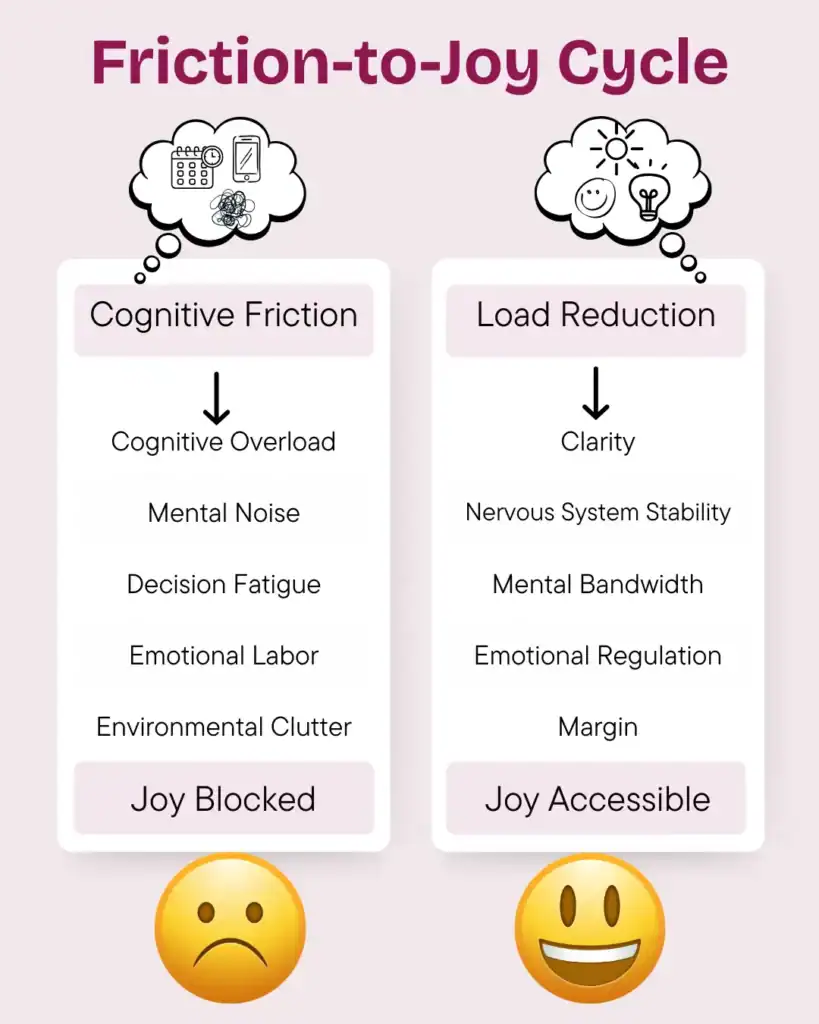
Joy becomes sustainable because it is no longer competing with constant mental friction. Think of it as the Friction-to-Joy Cycle.
The Friction-to-Joy Cycle
Cognitive Friction → Overload → Mental Noise → Joy Blocked
Load Reduction → Clarity → Nervous System Stability → Joy Accessible
When friction is reduced consistently across domains, your brain shifts from constant management to stable pattern recognition. You begin operating from clarity instead of survival.
First Step to Reduce Cognitive Load in Midlife
You do not need a total life overhaul. Start by identifying which domain feels heaviest right now:
- Are you exhausted by decisions?
- Overstimulated by your environment?
- Carrying invisible emotional strain?
- Physically stressed and wired?
Choose one area. Reduce one friction point. Build one low-decision strategy. Small reductions compound.
Reducing Cognitive Load Is Not a Lifestyle Trend
Reducing cognitive load in midlife is not minimalism for aesthetics.
It is not productivity hacking. It is not biohacking (DIY wellness approaches).
It is preserving mental energy so your brain can function efficiently during a season of layered responsibility.
Joy is not created by striving harder. It becomes available when mental noise is lowered.
The Goal: Sustainable Joy
Joyful living in midlife is not about adding more habits. It is about removing what overloads your cognitive system.
When cognitive load is optimized:
- You think more clearly.
- You respond instead of react.
- Your environment supports you.
- Your relationships feel lighter.
- Your nervous system rests.
Joy is not chased. It becomes sustainable.